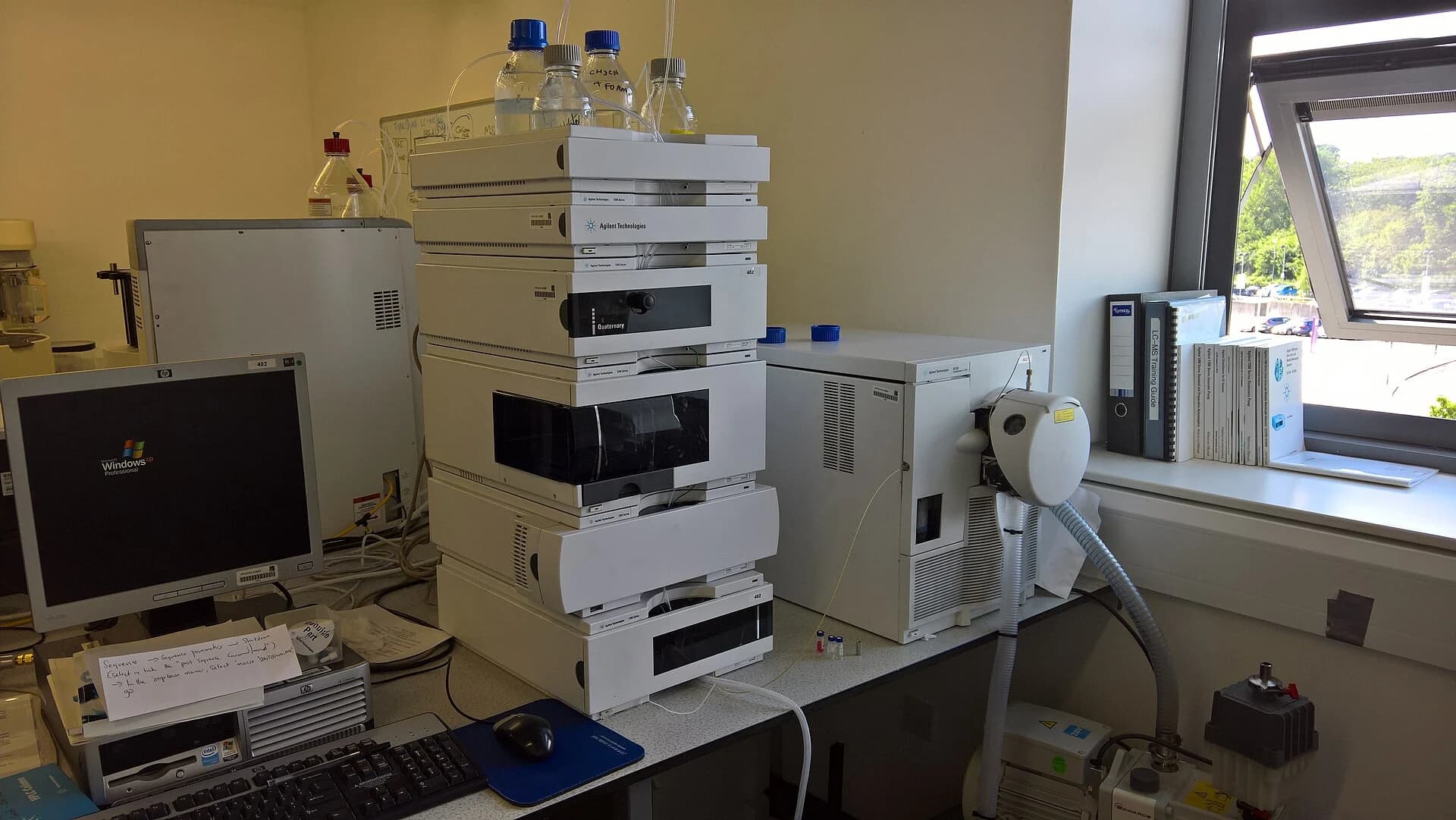
Choosing an additive is more than choosing purity
A mobile-phase additive can influence analyte charge, chromatographic behaviour and ionisation response. Selection should consider the column’s operating limits, ion source, detection mode and validated method. An LC-MS label does not guarantee identical performance for every analyte.
Formic acid, ammonium acetate and ammonium formate have different chemical roles. Replacing one with another is not simply a matter of adding the same amount; the change belongs in the laboratory’s method-control process.
Read v/v and w/v on premixed mobile phases
Formic-acid mixtures in water or acetonitrile and ammonium-acetate mixtures in water may use different concentration conventions. A 0.1% v/v statement is volume/volume; 0.1% w/v is mass/volume. These expressions are not directly interchangeable.
- Confirm the exact product code and composition of the premix.
- Read the concentration basis and manufacturer’s tolerance in the TDS.
- Do not assume a premix and an in-house preparation are equivalent without checking specifications.
TFA: peak shape and MS response are different questions
TFA can improve peak shape in some separations, but it can also cause ion suppression in mass spectrometry. The availability of a TFA-containing LC-MS-grade product does not make it the preferred choice for every MS method. Evaluate the required chromatographic performance together with acceptable MS response.
Information to provide before ordering
- Analyte group, column, ion source and method reference.
- Additive or premix, concentration convention and pack size.
- Required TDS, SDS and lot documentation.
- The laboratory’s change-control and suitability criteria when considering an alternative product.
Sources
Primary and institutional sources consulted in preparing this article.
 Weltnexx Editorial TeamExpert content on European sourcing, laboratory products and technical documentation.
Image credit: Nick Birse · Source · CC BY-SA 4.0