Match the standard to the measurement and sensor
Choosing a conductivity standard is not simply buying the most common bottle. Consider the expected sample range, sensor operating range, cell constant and available instrument calibration settings together. The catalogue’s 84, 147, 1413, 12880 and 50000 µS/cm products provide different levels; not every level suits every sensor.
Distinguish calibration from a subsequent verification check. The laboratory procedure or instrument manufacturer should define the points to use and the criteria for acceptance.
Why is 25 °C stated?
Solution conductivity changes with temperature. Read the reference temperature, measurement temperature and instrument compensation settings together. Applying the same temperature coefficient to a different standard or sample may be inappropriate; follow the product documentation and instrument instructions.
Check units and contamination
µS/cm and mS/cm are different scales of the same quantity: 1000 µS/cm equals 1 mS/cm. Do not confuse a difference in displayed units with a genuine difference between products. Contamination carried by containers or electrodes can affect assessment, particularly at low conductivity levels.
- Use the bottle according to manufacturer instructions and protect it from contamination.
- Record lot, use date, temperature and result.
- Take uncertainty and validity information only from the relevant product documentation.
Preparing an accurate quotation request
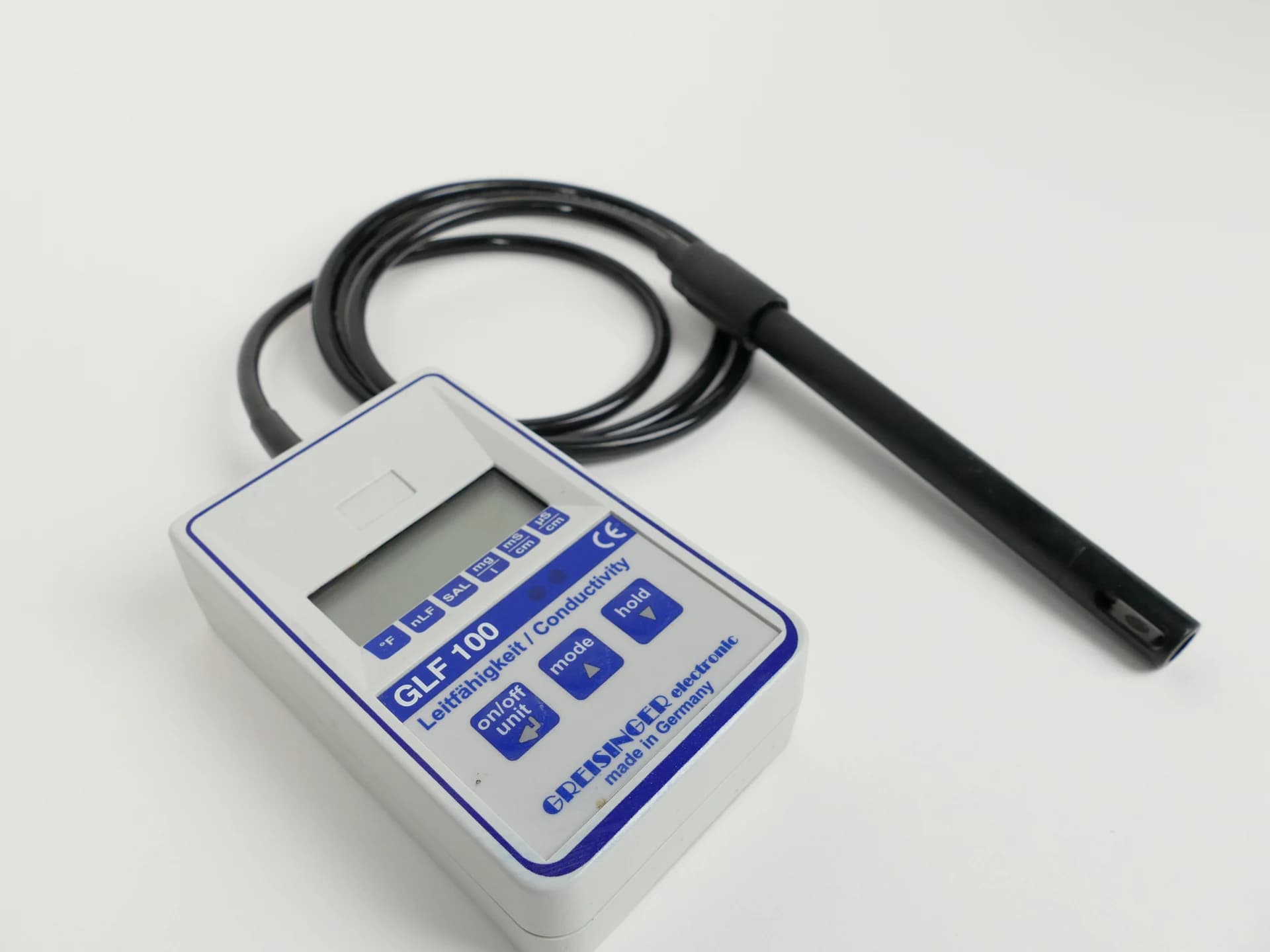
State the required conductivity and unit, reference temperature, instrument and sensor model, cell constant and pack size. Do not substitute another level or product without assessing technical equivalence. A conductivity standard is not interchangeable in purpose with a pH buffer or an IC analyte standard.
Sources
Primary and institutional sources consulted in preparing this article.
 Weltnexx Editorial TeamExpert content on European sourcing, laboratory products and technical documentation.
Image credit: MediaLab TH Köln · Source · CC BY-SA 4.0