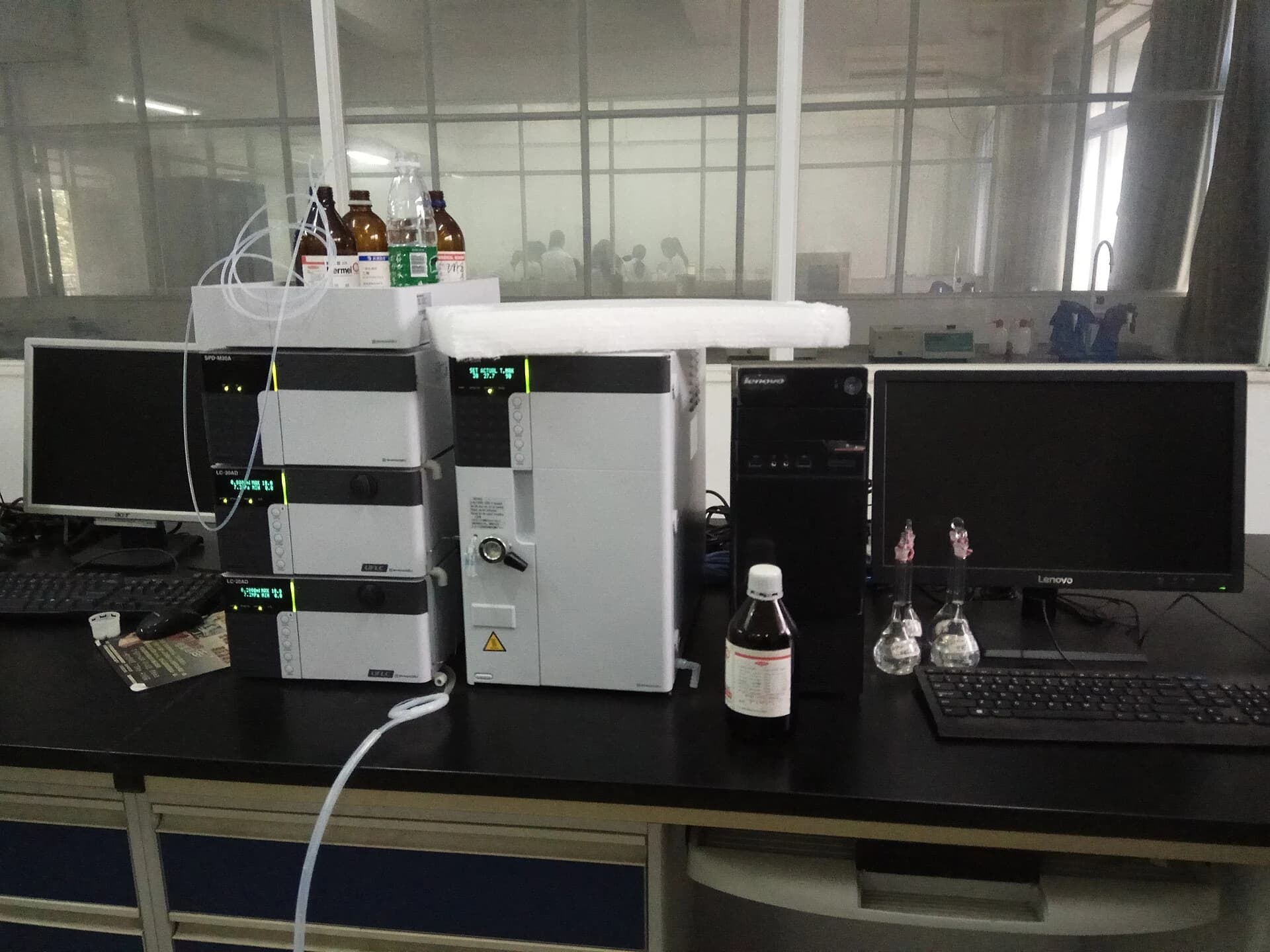
The short answer
HPLC-grade solvent is designed for liquid chromatography, but an LC-MS method can require tighter control of trace contaminants that create background ions, adducts or ion suppression. A solvent suitable for UV detection is therefore not automatically suitable for sensitive mass-spectrometric detection.
The correct choice depends on the detector, gradient, wavelength, sensitivity target and validated method. Grade names are useful screening labels, but the product specification and method requirements should make the final decision.
Why the detector changes the requirement
A UV or diode-array detector responds to compounds that absorb at the selected wavelength. The solvent must therefore have suitable UV transparency, low particulate content and stable baseline behaviour. The FDA's HPLC guidance notes that mobile-phase solvents should be highly pure and are most often HPLC grade.
Mass spectrometry detects ions rather than only UV absorption. Trace substances that are invisible in a conventional chromatogram may still appear as background signals, form adducts or compete during ionisation. A National Library of Medicine review notes that a solvent grade acceptable for conventional LC may not always be suitable for LC-MS.
When HPLC grade may be appropriate
Appropriate does not mean universal. Gradient methods can concentrate weak impurities and reveal them later as ghost peaks. Low-wavelength detection also makes solvent absorbance and stabiliser content more important.
- Routine isocratic HPLC with UV or fluorescence detection.
- Methods whose validated specification explicitly permits the selected solvent.
- Applications where UV cut-off, residue, water and particulate limits meet the method requirement.
- Situations where the same lot has passed system suitability and blank checks.
When LC-MS grade becomes important
LC-MS mobile phases should also use volatile additives compatible with the ion source and method. Non-volatile salts can contaminate the source and suppress analyte response. The solvent, water and additives must be assessed as one mobile-phase system.
- LC-MS or LC-MS/MS methods with electrospray or related ion sources.
- Trace-level analysis where background noise directly affects detection limits.
- Untargeted screening and accurate-mass work with many monitored ions.
- Methods sensitive to metal ions, non-volatile residues or ionic contaminants.
Common symptoms of an unsuitable solvent
- Unexpected blank peaks or a rising gradient baseline.
- High background ion count and unstable total-ion chromatograms.
- Reduced signal, variable response or poor detection limits.
- Adduct patterns that complicate identification.
- Deposits in the ion source or more frequent cleaning requirements.
- Different performance after changing solvent brand or lot.
A specification-led selection process
- Start with the validated method and detector type.
- Record wavelength, gradient range, flow, additives and target detection limit.
- Compare UV absorbance, residue after evaporation, water, acidity/alkalinity and particulate specifications.
- For LC-MS, review trace-ion, metal and MS-suitability testing where available.
- Use the same quality level for water and mobile-phase additives.
- Run solvent blanks, gradient blanks and system-suitability tests before samples.
- Qualify a new lot when the method is sensitive to background or trace impurities.
Practical conclusion
Choosing the highest grade for every method is not always necessary, but choosing only by price or label can create repeat analyses, downtime and unreliable results. The most economical solvent is the lowest grade that demonstrably meets the complete method requirement with sufficient margin.
For quotation and sourcing, provide the instrument, detector, method, required grade, additives, pack size and annual consumption. This allows technical equivalence to be checked before commercial comparison.
Sources
Primary and institutional sources consulted in preparing this article.
 Weltnexx Editorial TeamExpert content on European sourcing, laboratory products and technical documentation.